Showing posts with label education. Show all posts

Monday, 13 August 2018

Future Learn

FutureLearn is a Massive Open Online Course Platform. The courses are developed by partner organisations and can be studied using a mobile or tablet computer (although some courses may require additional technology - such as a piano for the Jazz Piano course).

FutureLearn was created by The Open University and (originally) twelve partner universities to provide on-line courses. Over the five plus years it has been in existence, the partners count has increased to 141.

The courses cover a wide area of study, technology, medicine, anthropology, marketing, arts, humanities, languages, music etc.

The courses are free, but access is for a limited amount of time. To extend access indefinitely and to receive a certificate of study requires a payment. A number of the courses are modules from a larger course including degree courses.

References:


Sunday, 8 July 2018

Programming the BBC micro:bit

One of the simplest methods of programming the micro:bit is using the web based MakeCode by Microsoft.

Here is an example of a "Hello World" program written using MakeCode.

This is the code generated as Javascript.

basic.forever(() => {
    basic.showString("Hello World!")
})

References

BBC micro:bit

The BBC micro:bit is a pocket sized programmable micro-controller designed for use in education.

As part of an education programme, these were given to schoolchildren to be used to teach the principles of programming. They were designed to be compact in size but have an assortment of sensors and feedback devices and to spark the creativity of children to the potential of programming.

After the first distribution, they were made available commercially for all to use.
The commercial version is supplied in a cardboard box containing the micro:bit, a small instruction manual and a safety guide. Minimum additional equipment is required, a USB to micro USB data cable (not a charging cable) and a computer (Windows/Mac/Linux) with a browser.
 The rear of the micro:bit, showing the labelling. As you can see it has a Bluetooth Low Energy aerial, magnetometer (compass), accelerometer, micro USB power and data socket, battery connector and processor. It also shows the connectors.
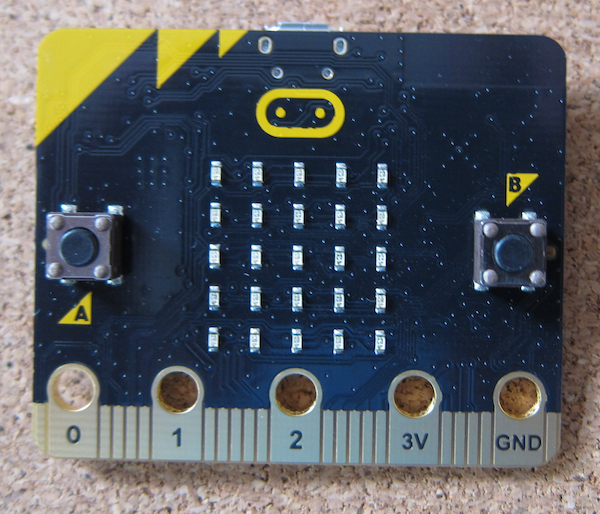
There are five big connectors suitable for crocodile clips, machine screws or conductive thread. On the front face they are labelled pins 0-2, 3V and Ground. Other pins are available through the edge connector. On this side is also the 5 x 5 LED display and two push buttons.

Reference