Showing posts with label BBC. Show all posts

Sunday, 17 February 2019

Kitronik :MOVE mini for the BBC mIcro:bit

I ordered a Kitronik MOVE mini robot from Pimoroni last year. This provides a battery powered chassis that can be controlled using an on-board BBC micro:bit.
The kit comes in a robust cardboard box, unfortunately not big enough to take the completed robot (but see later).

The components are neatly bagged up, and include the required AA batteries.
The body is made up of laser cut acrylic pieces. There are two continuous rotation servo motors to provide the motive power.

The controller board is designed to use countersunk screws to provide the connection between the micro:bit  and the board. This does mean that it limits the control to the two motors and the light bar (there is an option to isolate the light bar, giving access to an additional - optional - servo).
The back of the board. Note at bottom right the area to  cut to access the third servo).
The kit does not include a BBC micro:bit. As one of the options is to control the robot's own micro:bit using a second micro:bit, I ordered a second one.

I covered the BBC micro:bit in an earlier post.


The instructions to build the robot can be found here. They are generally straightforward (so much so I forgot to pause to photograph the stages).

The one thing to be aware of is that the controller board only operates on the batteries. I started testing the board assuming that the USB supply would power the micro:bit and the controller board and was testing it with the battery switched off. The micro:bit was fine, but the ZIP LED light bar was not lighting up. Switching the battery pack on solved the problem.
As you can see, the micro:bit is screwed to the controlled board.  The ZIP LEDs are above the micro:bit and the 5x5 matrix is visible.

Side view. The robot has two wheels and uses the front and rear of the side walls as stabilising rails.
The ZIP LEDs are very bright.

Sunday, 8 July 2018

Programming the BBC micro:bit

One of the simplest methods of programming the micro:bit is using the web based MakeCode by Microsoft.

Here is an example of a "Hello World" program written using MakeCode.

This is the code generated as Javascript.

basic.forever(() => {
    basic.showString("Hello World!")
})

References

BBC micro:bit

The BBC micro:bit is a pocket sized programmable micro-controller designed for use in education.

As part of an education programme, these were given to schoolchildren to be used to teach the principles of programming. They were designed to be compact in size but have an assortment of sensors and feedback devices and to spark the creativity of children to the potential of programming.

After the first distribution, they were made available commercially for all to use.
The commercial version is supplied in a cardboard box containing the micro:bit, a small instruction manual and a safety guide. Minimum additional equipment is required, a USB to micro USB data cable (not a charging cable) and a computer (Windows/Mac/Linux) with a browser.
 The rear of the micro:bit, showing the labelling. As you can see it has a Bluetooth Low Energy aerial, magnetometer (compass), accelerometer, micro USB power and data socket, battery connector and processor. It also shows the connectors.
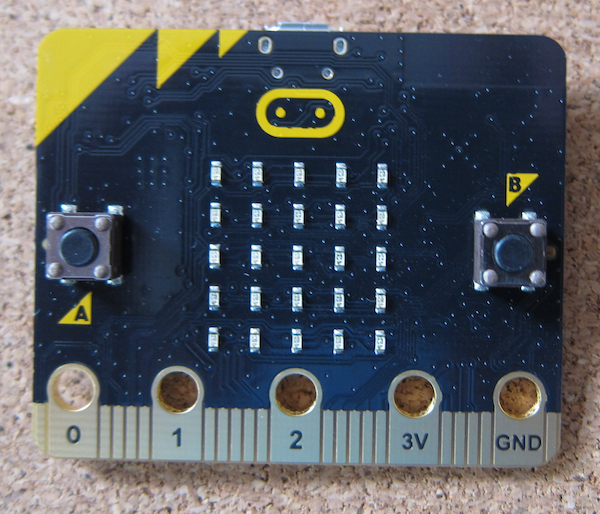
There are five big connectors suitable for crocodile clips, machine screws or conductive thread. On the front face they are labelled pins 0-2, 3V and Ground. Other pins are available through the edge connector. On this side is also the 5 x 5 LED display and two push buttons.

Reference